What Does Towing Capacity Mean for Your Pickup Truck
Towing capacity is the maximum weight your pickup truck can safely pull behind it. It depends on your truck’s engine, frame, axle ratio, and hitch setup. Understanding your towing capacity keeps you safe and prevents costly damage to your vehicle.
Key Takeaways
- Towing capacity is the max weight your truck can pull, set by the manufacturer.
- Key factors include engine power, axle ratio, curb weight, and hitch type.
- Payload and towing capacity are different but connected numbers.
- Exceeding your towing capacity can damage your engine, brakes, and transmission.
- Always check your truck’s owner manual or door jamb sticker for exact specs.
- A proper hitch, brake controller, and weight distribution setup are essential.
- Regular maintenance and smart loading make towing safer and easier.
📑 Table of Contents
- What Does Towing Capacity Mean for Your Pickup Truck?
- The Basics of Towing Capacity
- Key Terms You Need to Know
- How Towing Capacity Is Calculated
- Towing Capacity by Popular Pickup Trucks
- Common Towing Mistakes and How to Avoid Them
- Quick Tips for Safe and Smart Towing
- Expert Insights on Maximizing Your Towing Capacity
- Key Takeaways
- Conclusion
What Does Towing Capacity Mean for Your Pickup Truck?
If you own a pickup truck or plan to buy one, you have probably seen the term towing capacity more than a few times. It might look like a simple number on a sticker. But it is actually one of the most important specs to understand. Your towing capacity determines what you can safely pull behind your truck. It affects everything from road trips to hauling equipment for work.
So what does towing capacity really mean? In simple terms, it is the maximum weight your truck can tow without breaking safety limits or causing damage. Every truck has a specific number for this. It is set by the manufacturer after extensive testing. Going over that number is never a good idea. It can lead to serious mechanical problems or even dangerous driving conditions.
Many truck owners learn about towing capacity the hard way. They load up a trailer and hit the road. Then they notice the truck struggling. The engine overheats. The brakes feel weak. The transmission starts slipping. All of these problems can be avoided. You just need to know your truck’s limits and respect them.
This article breaks down everything you need to know about towing capacity. We will cover the key terms, how the number is calculated, and what factors affect it. We will also look at common mistakes and share practical tips. By the end, you will feel confident about towing with your pickup truck.
The Basics of Towing Capacity
What Exactly Is Towing Capacity?
Towing capacity is the maximum weight a vehicle can safely pull using a trailer or other towable load. For pickup trucks, this number can vary a lot. A half-ton truck might have a towing capacity of around 7,000 to 13,000 pounds. A heavy-duty truck can tow 30,000 pounds or more. The exact number depends on the make, model, engine, and configuration.
Manufacturers test each truck under controlled conditions. They measure how the engine, transmission, brakes, and frame handle the load. The resulting number is the towing capacity listed in the owner’s manual. This is the safest limit you should never exceed.
Why Towing Capacity Matters for Pickup Trucks
Pickup trucks are built for work and hauling. Whether you are pulling a boat, a travel trailer, or a flatbed, your truck’s towing capacity is the number that matters. Here is why it is so important:
- Safety: Exceeding your towing capacity can cause brake failure, loss of control, or jackknifing.
- Engine Health: Overloading strains the engine and shortens its lifespan.
- Transmission Life: Too much weight causes the transmission to overheat and wear out faster.
- Warranty Protection: Towing beyond your truck’s rated towing capacity can void your warranty.
- Insurance Coverage: Some insurance claims get denied if the truck was overloaded.
Understanding your towing capacity is not just about following rules. It is about protecting your investment and keeping everyone on the road safe.
Key Terms You Need to Know
Before you dive deeper into towing capacity, you need to understand a few related terms. These words come up often in the trucking world. Knowing them helps you make sense of your truck’s specs.
Gross Vehicle Weight Rating (GVWR)
Gross Vehicle Weight Rating, or GVWR, is the maximum total weight your truck can handle. This includes the truck itself, passengers, cargo, fuel, and the tongue weight of a trailer. Your truck’s GVWR is printed on a sticker inside the driver’s door jamb. It is also listed in the owner’s manual.
Here is a simple way to think about it. Your truck has a weight limit. Everything added together cannot go over that limit. The GVWR covers the truck and everything in it. Your towing capacity is separate but related.
Payload Capacity vs Towing Capacity
People often confuse payload capacity with towing capacity. They are different but connected. Payload capacity is the maximum weight your truck can carry in its bed and cabin. This includes passengers, gear, and cargo. Towing capacity is the weight your truck can pull behind it on a trailer.
Here is the key connection. When you tow a trailer, the trailer’s tongue weight adds to your truck’s payload. So if your truck has a payload of 1,500 pounds and your trailer tongue weighs 800 pounds, you only have 700 pounds left for cargo and passengers. Understanding both numbers is essential for safe truck towing.
Curb Weight Explained
Curb weight is the weight of your truck when it is empty. No passengers, no cargo, no trailer. Just the truck with a full tank of fuel. This number matters because it is used to calculate your truck’s available capacity for towing and payload.
The lighter your truck’s curb weight, the more room you have for towing and carrying load. Heavier trucks usually have higher towing capacity numbers. But they also use more fuel and can be harder to maneuver.
Gross Combined Weight Rating (GCWR)
Gross Combined Weight Rating, or GCWR, is the maximum total weight of your truck plus its trailer and cargo. This number combines the truck’s weight, the load inside it, and the full weight of the trailer. Your towing capacity plays a big role in determining your GCWR.
Think of GCWR as the big picture number. It tells you the absolute maximum weight your truck and trailer combo can handle on the road. Staying under this limit is critical for safe towing.
How Towing Capacity Is Calculated
Now that you know the key terms, let us look at how towing capacity is actually calculated. The process involves several factors working together. Manufacturers test each truck configuration to find the safe towing limit.
The Formula Behind Towing Numbers
There is no single simple formula. Instead, engineers look at many components at once. They test the engine’s output, the transmission’s cooling ability, the frame strength, and the brake system. They also consider the axle ratio and the hitch setup. All of these factors come together to set the towing capacity number.
A general idea is that stronger engines, heavier-duty frames, and better cooling systems allow for higher towing capacity. But every truck is different. A V8 engine does not always mean more towing power. The overall package matters most.
Factors That Affect Your Truck’s Towing Ability
Several key factors determine your truck’s towing capacity. Here are the most important ones:
- Engine Power: Horsepower and torque directly affect how much weight your truck can pull.
- Axle Ratio: A higher axle ratio, like 3.73 or 4.10, gives more pulling power for towing.
- Transmission: Trucks with heavy-duty transmissions handle towing loads better.
- Frame and Suspension: A stronger frame and upgraded suspension support heavier loads.
- Cooling System: Towing generates heat. Better cooling systems prevent overheating.
- Brake System: Larger brakes help stop a heavy trailer safely.
- Hitch Type: The right hitch receiver and ball mount are essential for safe towing.
Each of these factors plays a role. If one component is weak, it limits your towing capacity. That is why manufacturers rate each truck configuration individually.
Towing Capacity by Popular Pickup Trucks
Not all trucks are created equal when it comes to towing capacity. Different models and configurations offer different limits. Here is a look at how some popular pickup trucks compare.
| Truck Model | Engine | Max Towing Capacity | Payload Capacity |
|---|---|---|---|
| Ford F-150 | 3.5L EcoBoost V6 | 13,500 lbs | 2,080 lbs |
| Chevy Silverado 1500 | 6.2L V8 | 13,300 lbs | 2,280 lbs |
| Ram 1500 | 5.7L Hemi V8 | 12,750 lbs | 2,300 lbs |
| Toyota Tundra | 3.4L Twin-Turbo V6 | 12,000 lbs | 1,940 lbs |
| Ford F-250 (Heavy Duty) | 6.7L Power Stroke V8 | 20,000 lbs | 4,260 lbs |
| Ram 2500 | 6.7L Cummins Turbo Diesel | 19,780 lbs | 4,050 lbs |
| Chevy Silverado 2500HD | 6.6L Duramax Turbo Diesel | 18,500 lbs | 3,970 lbs |
As you can see from the table above, towing capacity increases as you move up in truck class. Half-ton trucks handle lighter loads well. Heavy-duty trucks excel at pulling large fifth-wheel trailers, horse trailers, and equipment haulers.
Half-Ton Trucks
Half-ton trucks like the Ford F-150, Chevy Silverado 1500, Ram 1500, and Toyota Tundra are the most popular choices for everyday towing. Their towing capacity ranges from about 7,000 to 13,500 pounds. These trucks are perfect for pulling small to medium trailers, boats, and camping setups.
If you are towing a travel trailer or a small boat, a half-ton truck is usually enough. Just make sure you stay within the towing capacity for your specific configuration. Engine choice, axle ratio, and cab style all matter.
Three-Quarter-Ton and Heavy-Duty Trucks
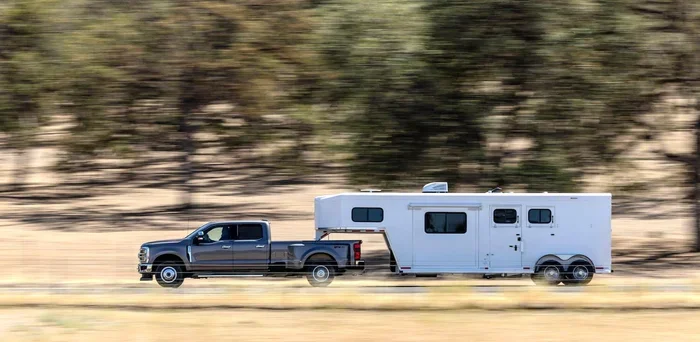
Heavy-duty trucks like the Ford F-250, Ram 2500, Chevy Silverado 2500HD, and Ram 3500 are built for serious towing. Their towing capacity starts around 18,000 pounds and can go well beyond 35,000 pounds with the right setup. These trucks are ideal for large trailers, RVs, and commercial equipment hauling.
If you plan to tow big loads regularly, a heavy-duty truck is the better choice. The stronger frame, better cooling, and higher axle ratios all contribute to a higher towing capacity. They also cost more, so consider your needs carefully.
Common Towing Mistakes and How to Avoid Them
Even experienced truck owners make mistakes when towing. These errors can be costly or dangerous. Here are the most common ones and how to avoid them.
Overloading Your Truck
The biggest mistake is exceeding your truck’s towing capacity. Some owners think a little extra weight will not hurt. It can. Overloading puts stress on every part of your truck. The engine works harder. The brakes wear out faster. The transmission overheats. In the worst case, you lose control of the vehicle.
To avoid this, always know your truck’s exact towing capacity. Check the owner’s manual. Look at the door jamb sticker. And never assume your truck can handle more than its rated limit.
Ignoring Tongue Weight
Tongue weight is the downward force the trailer puts on the hitch. It should be about 10 to 15 percent of the total trailer weight. Too much tongue weight pushes the rear of your truck down. This affects steering and braking. Too little tongue weight can cause the trailer to sway.
Use a tongue weight scale to check your setup. Adjust your cargo inside the trailer until the tongue weight is in the right range. This simple step makes a big difference in towing safety and stability.
Skipping the Right Towing Equipment
Many trucks come with a basic towing package. But that does not always mean they are ready for heavy loads. A proper towing package includes a heavy-duty hitch, wiring harness, brake controller, and sometimes an upgraded cooling system. Skipping any of these can limit your towing capacity and create safety risks.
Before you tow, make sure your truck has the right equipment installed. Check the hitch rating. Verify the brake controller is working. Ensure the wiring connects properly to the trailer lights. These small steps prevent big problems on the road.
Not Checking Tire Pressure
Tire pressure affects both your truck and your trailer. Underinflated tires create more rolling resistance and heat. This reduces fuel efficiency and increases the risk of blowouts. Overinflated tires reduce traction and give a harsher ride.
Check your tire pressure before every trip. Follow the recommended PSI listed on the tire placard inside your driver’s door. Also check your trailer tires. Proper tire maintenance is one of the easiest ways to stay safe while towing.
Quick Tips for Safe and Smart Towing
Towing does not have to be stressful. With the right preparation and habits, you can tow confidently and safely. Here are some quick tips to keep in mind:
- Know your numbers: Always check your truck’s towing capacity, payload, and GCWR before loading up.
- Distribute weight evenly: Place heavy items low and centered in the trailer. This improves stability.
- Use a weight distribution hitch: This helps balance the load between the front and rear axles of your truck.
- Install a brake controller: A trailer brake controller lets you apply the trailer’s brakes independently. This is essential for safe stopping.
- Allow more stopping distance: A loaded truck takes longer to stop. Keep a safe following distance.
- Check your mirrors: Make sure you can see both sides of the trailer. Adjust your mirrors before you drive.
- Practice in an empty lot: If you are new to towing, practice turning and backing up in a safe, open area first.
- Follow speed limits: Many states have lower speed limits for trucks towing trailers. Obey them for safety.
These tips may seem simple. But they make a huge difference in your towing experience. They help protect your truck, your trailer, and everyone sharing the road with you.
Expert Insights on Maximizing Your Towing Capacity
We spoke with several automotive experts about towing capacity and how to get the most out of your truck. Here is what they had to say.
Choose the right axle ratio for your needs. A taller axle ratio like 3.55 works well for highway cruising with light loads. A shorter ratio like 4.10 gives you more pulling power for heavy towing. The right choice depends on how you use your truck most often.
Do not forget about maintenance. Regular oil changes, brake inspections, and transmission fluid checks are even more important when you tow. The extra stress on your truck means components wear faster. Staying on top of maintenance keeps your towing capacity performance consistent and safe.
Consider a tuning or programmer. Some truck owners install performance tuners to unlock extra torque. This can improve towing performance. But always check with your manufacturer first. Some tuners can void your warranty if used beyond recommended settings.
Invest in the right hitch. A Class V hitch receiver is the strongest option available. It is rated for the heaviest loads. Make sure the hitch is properly installed and rated for your truck’s towing capacity. A cheap or poorly installed hitch is a serious safety risk.
Key Takeaways
- Towing capacity is the maximum weight your truck can safely pull, set by the manufacturer.
- Key factors include engine power, axle ratio, curb weight, and hitch type.
- Payload and towing capacity are different but connected numbers you must both understand.
- Exceeding your towing capacity can damage your engine, brakes, and transmission.
- Always check your truck’s owner manual or door jamb sticker for exact specs.
- A proper hitch, brake controller, and weight distribution setup are essential for safe towing.
- Regular maintenance and smart loading make towing safer and easier.
Conclusion
Towing capacity is more than just a number on a spec sheet. It is the foundation of safe and effective towing with your pickup truck. When you understand what towing capacity means, you can plan better, load smarter, and drive with confidence. You protect your truck, your cargo, and everyone else on the road.
Take the time to learn your truck’s specific towing capacity. Check the owner’s manual. Look at the door jamb sticker. Know the difference between payload and towing limits. And always use the right equipment for the job. These steps might seem small, but they make a world of difference.
Whether you are pulling a small boat to the lake or a large RV cross-country, your towing capacity guides every decision. Respect that limit, prepare properly, and enjoy the ride. Safe towing starts with understanding what your truck can do and staying within its limits.
Frequently Asked Questions
What happens if you exceed towing capacity?
Exceeding your towing capacity puts extreme stress on your engine, transmission, and brakes. It can cause overheating, brake failure, and loss of vehicle control. It may also void your truck’s warranty and insurance coverage.
How do I find my truck’s towing capacity?
Check your truck’s owner’s manual or the sticker inside the driver’s door jamb. You can also visit the manufacturer’s website and look up your specific truck configuration. The towing capacity varies by engine, axle ratio, and trim level.
Does adding a towing package increase towing capacity?
A proper towing package includes the right hitch, wiring, brake controller, and sometimes a cooling upgrade. These additions help your truck reach its full rated towing capacity. But they do not increase the maximum limit set by the manufacturer.
Is tongue weight part of towing capacity?
Tongue weight is part of your truck’s payload, not directly part of towing capacity. However, the tongue weight from your trailer reduces the available payload for other cargo and passengers. You must account for both numbers when towing.
Can I tow at my truck’s maximum towing capacity right away?
It is best to start with lighter loads and gradually work up. This lets you get comfortable with how your truck handles a trailer. It also gives you time to check all equipment and adjust your driving habits for safe truck towing.
Does tire size affect towing capacity?
Yes, tire size can affect your towing capacity. Larger tires change the gear ratio and can impact towing performance. Always use the tire size recommended by the manufacturer for your specific truck configuration.