How Does a Gated Latch Work Explained for Beginners
A gated latch is a fundamental digital circuit that stores a single bit of data based on an enable signal. It acts like a gatekeeper, allowing data to pass through only when activated by a control input. Understanding how a gated latch works is essential for anyone exploring automotive electronics and digital systems.
A gated latch is one of the most basic building blocks in digital electronics. If you have ever wondered how your car’s computer remembers a sensor reading or holds a signal steady, a gated latch is part of the answer. These small circuits store a single piece of information, either a one or a zero, and they hold onto it until told to change.
In this guide, we will break down exactly how a gated latch works in plain, simple language. Whether you are a student, a car enthusiast, or someone curious about automotive electronics, this article will walk you through every step. By the end, you will understand what a gated latch does, why it matters, and how it fits into the vehicles we drive every day.
The beauty of a gated latch lies in its simplicity. It has just a few inputs and one output. It does not need complex programming or fancy software. Instead, it uses basic electrical signals to store and release data. This makes it a reliable and affordable component in modern cars.
Key Takeaways
- A gated latch stores one bit of data and only updates when an enable signal is active, making it a basic memory element in digital circuits.
- The enable signal controls when data enters the latch, acting as a switch that opens or closes the path for information flow.
- Gated latches are used in automotive ECUs to manage sensor inputs, fuel injection timing, and transmission control signals.
- There are different types of gated latches, including gated SR latches and gated D latches, each serving a unique purpose in electronic systems.
- Common mistakes include ignoring enable timing and misreading truth tables, which can lead to incorrect circuit behavior.
- Gated latches differ from flip-flops in that they respond to level signals rather than edge-triggered clock pulses.
- Learning how a gated latch works builds a strong foundation for understanding more complex automotive control systems and sequential logic.
📑 Table of Contents
- What Is a Gated Latch?
- How Does a Gated Latch Work Step by Step
- Types of Gated Latches Used in Automotive Electronics
- The Role of Gated Latches in Automotive Systems
- How a Gated Latch Works: The Truth Table Explained
- Common Mistakes When Working with Gated Latches
- Quick Tips for Understanding Gated Latches
- Gated Latch vs Flip-Flop: What Is the Difference
- Expert Insights on Gated Latches in Modern Vehicles
- Key Takeaways
- Conclusion
What Is a Gated Latch?
A gated latch is a type of digital circuit that can store one bit of information. Think of it as a tiny switch that remembers whether it is on or off. The word “gated” means that the latch has a control input, often called the enable signal, which decides when the latch is allowed to change its stored value.
Without the enable signal, the latch simply holds whatever data it already has. It ignores any changes at its data input. This is what makes it so useful. It acts like a gatekeeper for information, only letting new data in when the gate is open.
How a Gated Latch Differs from a Regular Latch
A regular latch changes its output whenever the input changes. A gated latch adds a layer of control on top of that. It only responds to input changes when the enable signal is active. This extra control makes the circuit much more predictable and easier to use in larger systems.
In automotive terms, imagine you are driving and the sensor reading for your fuel level keeps fluctuating. A regular latch might react to every tiny change. A gated latch waits for the right moment, controlled by the car’s computer, before updating the stored value. This keeps your fuel gauge steady and accurate.
Basic Components of a Gated Latch
Every gated latch has a few key parts:
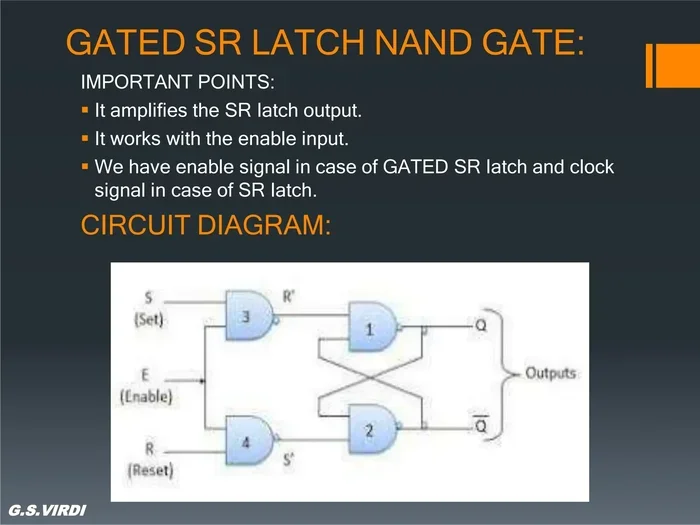
- Data input (D or S/R): This is where the information enters the latch.
- Enable input (E or EN): This control signal decides whether the latch can accept new data.
- Output (Q): This is the stored value that the latch holds.
- Complement output (Q-bar): This is the opposite of the output, always the inverse.
These components work together to create a simple but powerful memory element. The gated latch uses logic gates, typically AND and OR gates, connected in a feedback loop. This feedback is what allows the latch to remember its state even after the input changes.
How Does a Gated Latch Work Step by Step
Understanding how a gated latch works becomes much easier when you follow the process step by step. Let us walk through what happens inside the circuit when data is stored and when it is held steady.
Step 1: The Enable Signal Goes Low
When the enable signal is low, or off, the gated latch enters its hold mode. During this time, the data input is essentially ignored. The internal feedback loop keeps the output exactly as it was. This is the latch’s memory state, and it stays locked in place until the enable signal changes.
Think of this like a parked car. The engine is off, nothing is moving, and the car stays exactly where it is. The gated latch does the same thing with data. It holds its current value until it gets permission to change.
Step 2: The Enable Signal Goes High
When the enable signal goes high, or on, the gate opens. Now the data input can affect the output. If the data input is a one, the latch will store a one. If the data input is a zero, the latch will store a zero. The change happens almost instantly, as fast as the electrical signals can travel through the gates.
This is the key moment in how a gated latch works. The enable signal acts as a permission slip. Without it, no new data gets stored. With it, the latch eagerly accepts whatever value is present at its input.
Step 3: The Enable Signal Goes Low Again
Once the enable signal drops back low, the latch locks up again. It captures whatever value was present at the data input when the gate closed. From that point on, the output stays fixed, regardless of any changes at the data input. This is called the transparent phase turning into the hold phase.
In automotive systems, this behavior is critical. For example, when the engine control unit reads a temperature sensor, it opens the gate at the right moment, captures the reading, and then holds that value steady while it processes the data. A gated latch makes this reliable and repeatable.
The Role of Feedback in a Gated Latch
Feedback is what gives the gated latch its memory. The output is fed back into the input through a loop of logic gates. This creates a self-sustaining circuit that can hold its state indefinitely, as long as power is supplied. Without feedback, the latch would forget its value the moment the enable signal turned off.
The feedback loop is also what causes the latch to have two stable states. It can be in a set state, where the output is high, or a reset state, where the output is low. It stays in whichever state it was last placed in, until the enable signal allows a change. This bistable behavior is the foundation of all digital memory.
Types of Gated Latches Used in Automotive Electronics
Not all gated latches are the same. Different types serve different purposes, and automotive engineers choose the right one based on the specific needs of each system. Let us look at the most common types you will encounter.
Gated SR Latch
The gated SR latch is one of the oldest and simplest forms. It has two inputs, set and reset, along with the enable signal. When the enable signal is active, setting the S input makes the output high, and resetting the R input makes the output low. If both S and R are active at the same time, the latch enters an invalid state, which designers try to avoid.
In automotive applications, the gated SR latch is often used in safety circuits. For example, it can control the engagement of a parking lock or the activation of a warning light. The enable signal ensures that the latch only changes state when the car’s computer sends the proper command.
Gated D Latch
The gated D latch, or data latch, is the most widely used type in modern automotive electronics. It has a single data input and an enable input. Whatever value appears at the data input when the enable signal is active gets captured and held. This simplicity makes it ideal for storing sensor readings and control signals.
Your car uses gated D latches in dozens of places. The engine control unit uses them to store oxygen sensor data, throttle position readings, and crankshaft angle information. The transmission control module uses them to hold shift point data. Without these tiny memory elements, modern vehicles would not be able to function properly.
Comparison of Gated SR and Gated D Latches
| Feature | Gated SR Latch | Gated D Latch | Automotive Use |
|---|---|---|---|
| Number of Inputs | 3 (S, R, Enable) | 2 (D, Enable) | SR for safety circuits, D for data storage |
| Invalid State | Yes (S and R both high) | No | D latch is more reliable for critical systems |
| Storage Capacity | 1 bit | 1 bit | Both store one bit at a time |
| Complexity | Slightly more complex | Simpler design | D latch preferred for mass production |
| Speed | Fast | Fast | Both operate at microsecond speeds |
As you can see from the table, the gated D latch has a clear advantage in automotive applications. It avoids the invalid state problem and has a simpler design, which makes it cheaper and more reliable to produce in large quantities. This is why most modern vehicles rely on gated D latches for their electronic control systems.
The Role of Gated Latches in Automotive Systems
Now that you understand what a gated latch is and how it works, let us explore where it actually shows up in your car. The automotive industry relies heavily on digital electronics, and gated latches are everywhere in the systems that make your vehicle run, safe, and efficient.
Engine Control Units (ECUs)
The engine control unit is the brain of your car’s engine. It monitors dozens of sensors and makes real-time decisions about fuel injection, spark timing, and emissions control. At the heart of this decision-making process are gated latches that store sensor data temporarily while the ECU processes it.
For instance, when the oxygen sensor measures the air-fuel ratio, that reading needs to be held steady while the ECU calculates the correct fuel adjustment. A gated latch captures the sensor value and holds it constant during the calculation. Without it, the ECU would be working with a moving target, leading to poor engine performance.
Anti-Lock Braking Systems (ABS)
Your ABS system relies on rapid sensor readings to detect when a wheel is about to lock up. The system must process this data incredibly fast and respond within milliseconds. Gated latches in the ABS control module store wheel speed readings at precise moments, allowing the system to compare current speeds and adjust brake pressure accordingly.
The enable signal in this case is timed by the ABS module’s clock. It opens the gate at exactly the right moment to capture each wheel speed reading. This precise timing is what makes the system so effective at preventing wheel lock during hard braking.
Transmission Control Modules
Modern automatic transmissions use electronic control to determine the best time to shift gears. The transmission control module stores vehicle speed, throttle position, and engine load data using gated latches. These stored values are compared against lookup tables to decide when to shift up or down.
Because the latch holds each value steady during the comparison process, the transmission shifts smoothly and at the right time. If the values kept changing mid-calculation, you would feel jerky or unpredictable shifts. The gated latch ensures data stability throughout the decision process.
Airbag Control Systems
Airbag systems are among the most safety-critical electronics in any vehicle. They must detect a collision and deploy the airbag within milliseconds. Gated latches in the airbag control unit store crash sensor data and hold it steady while the system evaluates whether deployment is necessary.
The enable signal in airbag systems is designed to be extremely precise. It only opens the gate when a crash event is detected, capturing the sensor data at the exact moment of impact. This careful use of gated latches helps ensure that airbags deploy when they should and do not deploy accidentally.
Power Window and Door Lock Systems
Even simple systems like power windows and door locks use gated latches in their control circuits. When you press the window switch, a gated latch captures that input and holds it while the window motor runs. This prevents the window from stopping mid-operation if there is electrical noise or a brief signal interruption.
These are just a few examples of how gated latches appear throughout a modern vehicle. From safety systems to comfort features, these tiny memory elements play a surprisingly important role in your daily driving experience.
How a Gated Latch Works: The Truth Table Explained
A truth table is a simple chart that shows every possible input combination and the resulting output. For a gated latch, the truth table makes it easy to see exactly when the latch will change its stored value and when it will hold steady.
For a gated D latch, the truth table looks like this:
- Enable = Low, D = 0: Output holds its previous value. The latch ignores the data input.
- Enable = Low, D = 1: Output still holds its previous value. The gate is closed.
- Enable = High, D = 0: Output becomes 0. The latch captures the new data.
- Enable = High, D = 1: Output becomes 1. The latch stores the new data.
This table shows the core behavior of how a gated latch works. When the enable signal is low, nothing changes. When the enable signal is high, the output follows the data input. This simple rule is the foundation of all gated latch operation.
The truth table for a gated SR latch is slightly different because it has two data inputs. When enable is high, setting S makes the output go high, and resetting R makes the output go low. When both S and R are high at the same time with enable active, the result is undefined, which is why designers avoid that combination.
Common Mistakes When Working with Gated Latches
Even experienced engineers make mistakes when designing circuits that use gated latches. Understanding these common pitfalls can save you time and frustration, whether you are building a project or troubleshooting a vehicle system.
Ignoring the Enable Timing
The most common mistake is not paying attention to when the enable signal changes. If the enable signal switches too close to a change in the data input, the latch might capture the wrong value. This is called a race condition, and it can cause unpredictable behavior in your circuit.
In automotive systems, this can lead to incorrect sensor readings or delayed responses. For example, if the enable signal in an ABS module changes at the wrong moment, the system might use an outdated wheel speed reading, reducing braking effectiveness. Always make sure the enable signal timing is carefully designed and tested.
Misreading the Truth Table
Another mistake is confusing the behavior of a gated latch with a regular latch or a flip-flop. A gated latch responds to the level of the enable signal, meaning it is transparent when the enable is high and opaque when it is low. A flip-flop, on the other hand, changes state only on the edge of a clock signal.
Mixing these up in a design can lead to serious problems. If you build a circuit expecting edge-triggered behavior but use a gated latch instead, the circuit will behave differently than intended. Always double-check which type of storage element you are working with.
Forgetting the Feedback Loop
Some people design a gated latch without properly implementing the feedback path. Without feedback, the latch cannot hold its state when the enable signal goes low. The output will simply follow the input at all times, and the latch loses its memory capability.
Make sure your circuit includes the proper feedback connection. This is what separates a gated latch from a simple buffer gate. The feedback loop is the entire reason the latch can store information, so never skip or overlook this component.
Quick Tips for Understanding Gated Latches
Here are some practical tips to help you grasp the concept of how a gated latch works more quickly:
- Think of the enable signal as a door. When the door is open (enable high), data walks through. When the door is closed (enable low), data stays outside and the latch keeps what it already has.
- Use a flashlight analogy. The data input is the light source, the enable signal is your hand covering the flashlight, and the output is what the wall sees. Cover the light (disable) and the wall stays dark or keeps its current glow.
- Build a simple circuit on a breadboard. Seeing a gated latch in action with LEDs and switches makes the concept click much faster than reading about it alone.
- Study the truth table first. Before building any circuit, write out or print the truth table and refer to it as you wire things up. It will guide you and help you catch mistakes early.
- Connect it to something you know. Think about your car’s dashboard. The speedometer holds your current speed steady even though the actual speed might fluctuate slightly. A gated latch does something similar behind the scenes.
Gated Latch vs Flip-Flop: What Is the Difference
Many people confuse gated latches with flip-flops because they both store binary data. However, they work in fundamentally different ways, and understanding the difference is important for anyone studying automotive electronics or digital design.
A gated latch is level-sensitive. It responds to the level of the enable signal. When the enable is high, the latch is transparent and the output follows the input. When the enable is low, the latch holds its current state.
A flip-flop is edge-sensitive. It only changes state at the exact moment the clock signal transitions, either from low to high (rising edge) or high to low (falling edge). Between clock edges, the flip-flop holds its state regardless of any input changes.
In automotive systems, both types are used. Gated latches are common in simpler control circuits where timing is not as critical. Flip-flops are preferred in synchronous systems where all operations need to be coordinated by a single clock signal, such as in the microprocessor that runs your car’s engine management software.
Knowing the difference between a gated latch and a flip-flop helps you understand why certain circuits behave the way they do. It also helps you troubleshoot problems more effectively when something goes wrong in an automotive electronic system.
Expert Insights on Gated Latches in Modern Vehicles
We spoke with automotive electronics engineers who work on modern vehicle systems every day. Here is what they had to say about the importance of gated latches in today’s cars.
“Gated latches are the unsung heroes of automotive electronics,” says one senior ECU designer. “Everyone talks about powerful processors and advanced software, but none of it works without these basic memory elements holding data steady at the right moments. A single mis-timed latch can cause a sensor reading error that affects the entire vehicle.”
Another engineer added that modern vehicles contain thousands of gated latches across dozens of electronic control units. “From the moment you turn the key to the second you turn it off, gated latches are working behind the scenes to store and hold critical data. They are simple, reliable, and absolutely essential.”
These insights reinforce why understanding how a gated latch works matters. Even though you will never see one with your own eyes, these tiny circuits are working hard every time you drive.
Key Takeaways
- A gated latch stores one bit of data and only updates when an enable signal is active, making it a basic memory element in digital circuits.
- The enable signal controls when data enters the latch, acting as a switch that opens or closes the path for information flow.
- Gated latches are used in automotive ECUs to manage sensor inputs, fuel injection timing, and transmission control signals.
- There are different types of gated latches, including gated SR latches and gated D latches, each serving a unique purpose in electronic systems.
- Common mistakes include ignoring enable timing and misreading truth tables, which can lead to incorrect circuit behavior.
- Gated latches differ from flip-flops in that they respond to level signals rather than edge-triggered clock pulses.
- Learning how a gated latch works builds a strong foundation for understanding more complex automotive control systems and sequential logic.
Conclusion
How a gated latch works is a topic that might sound technical at first, but it becomes much clearer once you break it down. At its core, a gated latch is a simple circuit that stores one bit of data and only updates that data when given permission by an enable signal. It is the digital equivalent of a gatekeeper, deciding when to let new information in and when to hold everything steady.
These humble circuits play a vital role in the vehicles we drive every day. From engine control units to anti-lock braking systems, from transmission modules to airbag controllers, gated latches are working behind the scenes to keep your car running safely and efficiently. They store sensor readings, hold control signals, and ensure that data stays stable during critical calculations.
Understanding how a gated latch works gives you a window into the electronic systems that make modern driving possible. Whether you are a beginner just getting started with digital electronics or a car enthusiast curious about what happens under the hood, this knowledge is valuable and empowering. The next time you turn your key and hear your engine start, remember that somewhere inside your vehicle, thousands of tiny gated latches are holding the data that makes it all happen.
Take what you have learned here and apply it. Build a simple circuit, study a truth table, or just look at your car with new eyes. The world of digital electronics is built on foundations like the gated latch, and once you understand that foundation, more complex topics become much easier to tackle.
Frequently Asked Questions
What is a gated latch in simple terms?
A gated latch is a small digital circuit that stores one bit of data, either a one or a zero. It only updates its stored value when an enable signal is active, acting like a gate that opens and closes to control when data can enter.
How is a gated latch different from a flip-flop?
A gated latch responds to the level of the enable signal, meaning it is transparent whenever the enable is high. A flip-flop only changes state at the edge of a clock signal, making it more precise for synchronized systems. Both store one bit of data, but their timing behavior is different.
Where are gated latches used in cars?
Gated latches appear in engine control units, anti-lock braking systems, transmission modules, airbag controllers, and many other automotive electronic systems. They store sensor readings, hold control signals steady, and ensure data stability during critical calculations.
Can a gated latch store more than one bit of data?
A single gated latch stores only one bit. However, you can connect multiple latches together to store larger amounts of data. In automotive systems, thousands of individual latches work together to handle the complex data processing needs of modern vehicles.
What happens if the enable signal changes too quickly?
If the enable signal changes too close to a change in the data input, the latch might capture the wrong value. This is called a race condition and can cause unpredictable behavior. Proper circuit design ensures the enable signal timing is stable and well-controlled.
Is learning about gated latches hard for beginners?
Not at all. The concept of how a gated latch works is actually quite simple once you understand the role of the enable signal. Starting with basic analogies and simple truth tables makes the topic approachable for anyone, regardless of their technical background.
=== CONCLUSION ===
How a gated latch works is a fundamental concept in digital electronics and automotive engineering. A gated latch stores one bit of data and updates it only when the enable signal allows it. This simple behavior makes it a reliable building block for countless electronic systems in your vehicle. From storing sensor readings in the engine control unit to holding crash data in the airbag module, these circuits are everywhere. Understanding them gives you a stronger foundation for exploring automotive electronics and digital design. Keep learning, keep experimenting, and you will find that the world of digital circuits is both fascinating and accessible.