What Happens When a Car Goes on a Horizontal Circular Road
When a car goes on a horizontal circular road, several physics forces work together to keep the vehicle on its curved path. Centripetal force, friction, and speed all play critical roles in ensuring a safe and smooth turn. Understanding these basics helps drivers navigate circular roads with confidence and avoid common dangers like skidding or loss of control.
Have you ever driven around a roundabout or a curved highway and wondered why your car doesn’t just fly off the road? The answer lies in a fascinating mix of physics and engineering. When a car goes on a horizontal circular road, multiple forces come into play. These forces work behind the scenes every single time you take a turn.
Understanding what happens during this process is not just for physics students. It is incredibly useful for everyday drivers. Whether you are navigating a city roundabout or tackling a winding country road, knowing the basics of circular motion can make you a safer and more confident driver. This article breaks it all down in simple, easy-to-understand terms.
We will explore the forces at work, discuss why speed matters so much, and share practical tips to keep you safe on curved roads. By the end, you will have a clear picture of the science behind every turn you take. Let us dive right in.
Key Takeaways
- Centripetal force keeps the car moving in a circle: Without it, the vehicle would fly off the road in a straight line.
- Friction between tires and road is essential: It provides the grip needed to maintain the circular path safely.
- Speed and radius are directly linked: Higher speeds or tighter curves require more friction and careful driving.
- Banking angle is absent on horizontal roads: This makes friction the sole force preventing the car from sliding outward.
- Common mistakes like speeding on curves cause accidents: Knowing the limits helps you stay safe.
- Weather and road conditions change everything: Wet or icy roads drastically reduce the friction available for turning.
- Practical tips can make circular driving safer: Smooth steering, controlled speed, and proper tire maintenance all help.
📑 Table of Contents
- The Basics of Circular Motion for Vehicles
- Key Forces Acting on a Car in a Horizontal Circle
- Speed, Radius, and Safety on Circular Roads
- Why Horizontal Circular Roads Are Different from Banked Roads
- Common Mistakes Drivers Make on Curved Roads
- Practical Tips for Safe Driving on Circular Roads
- Expert Insights on Vehicle Dynamics and Circular Motion
- Key Takeaways
- Conclusion
The Basics of Circular Motion for Vehicles
Before we get into the details, let us cover the fundamentals. Circular motion is when an object follows a curved or circular path. For a car, this happens when it turns along a road that forms part of a circle. The road is flat, or horizontal, which means there is no banking or slanting involved.
In a straight line, a car moves with ease. But the moment it turns, things change. The direction of the car shifts constantly. This change in direction means the car is accelerating, even if its speed stays the same. This type of acceleration is called centripetal acceleration. It always points toward the center of the circle.
What Is Centripetal Force?
Centripetal force is the force that keeps an object moving in a circular path. It pulls the car toward the center of the circle. Without this force, the car would continue moving in a straight line due to inertia. Inertia is the tendency of an object to resist changes in its motion.
Think of it this way. Imagine you are in a car taking a sharp left turn. Your body feels like it is being pushed to the right. That is not a real force pushing you outward. It is your body’s inertia trying to keep you moving in a straight line. The car door or seatbelt provides the centripetal force that keeps you moving in the circle with the car.
For a car on a horizontal circular road, the centripetal force comes from one main source: friction between the tires and the road surface. This is why tire condition and road surface matter so much when driving on curves.
The Role of Friction in Turning
Friction is the unsung hero of circular driving. It is the force that grips the tires to the road and prevents the car from sliding. When a car turns on a flat, horizontal road, the tires steer in the direction of the curve. The friction between the rubber and the pavement provides the necessary centripetal force.
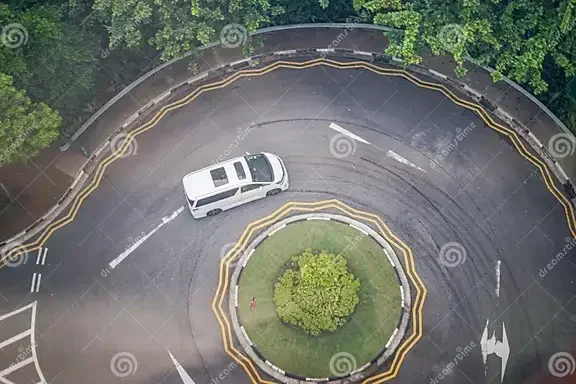
Here is a simple way to think about it. Picture a car moving at a steady speed around a circular track. The tires are turned toward the center of the circle. Friction pushes the car inward, toward that center. This inward push is exactly what keeps the car on its circular path.
If there is no friction, the car would simply slide straight forward, tangent to the circle. This is what happens on icy roads. The lack of grip means the tires cannot generate enough friction to provide the centripetal force needed for the turn.
Key Forces Acting on a Car in a Horizontal Circle
Several forces work together when a car navigates a flat, curved road. Let us break them down one by one so you can see how they interact.
Gravitational Force
Gravitational force pulls the car downward toward the Earth. This force is equal to the weight of the car. It acts vertically and is balanced by the road surface pushing back up. This upward push is called the normal force. On a horizontal road, the normal force and gravitational force are equal in size but opposite in direction.
Because the road is flat, neither of these forces contributes to the turning motion. They only keep the car pressed against the road surface. The entire job of making the car turn falls on friction.
Centripetal Acceleration
Centripetal acceleration is the acceleration directed toward the center of the circle. It is always perpendicular to the car’s velocity. The formula for centripetal acceleration is a equals v squared divided by r. In this formula, v stands for the car’s speed, and r stands for the radius of the circular path.
This means that the tighter the curve (smaller radius), the greater the acceleration needed to stay on the path. Similarly, the faster the car moves, the greater the acceleration required. Both of these factors directly affect how much friction is needed to make the turn safely.
Velocity and Its Direction
A car moving in a circle has a constant speed but a changing velocity. This is because velocity is a vector quantity. It has both magnitude (speed) and direction. As the car moves along the circular path, its direction keeps changing. At every point, the velocity vector points tangent to the circle.
This constant change in direction is what makes circular motion possible. It also explains why taking a curve at high speed feels so intense. Your body is constantly adjusting to a new direction of motion. The faster you go, the more dramatic that adjustment becomes.
Speed, Radius, and Safety on Circular Roads
The relationship between speed, radius, and safety is critical for drivers. When a car goes on a horizontal circular road, these two factors determine how much friction is required. Let us explore this in detail.
How Speed Affects Your Turn
Speed has a huge impact on circular driving. The centripetal force needed increases with the square of the speed. This means that doubling your speed requires four times the friction to maintain the same turn. It is a dramatic relationship.
For example, if a car needs a certain amount of friction to safely navigate a curve at 30 miles per hour, it would need four times that friction at 60 miles per hour. Most tires simply cannot provide that level of grip. This is why speeding on curved roads is so dangerous.
Safe speed limits on curved roads are not arbitrary. They are calculated based on the radius of the curve and the expected friction between tires and road. Respecting these limits is one of the best things you can do for your safety.
The Importance of Turning Radius
The turning radius of a road curve refers to the radius of the circular path the car follows. A smaller radius means a tighter, sharper curve. A larger radius means a gentler, more gradual turn.
Tighter curves require more centripetal force for the same speed. This is why sharp turns on highways often have lower speed limits than gentle curves. Road designers carefully consider the radius when planning curves, especially in areas with high traffic or challenging terrain.
As a driver, you should always adjust your speed based on how tight a curve feels. If the turn is sharp, slow down more than you think you need to. It is always better to arrive at your destination a few seconds late than to risk losing control of your vehicle.
Calculating the Safe Speed for a Curve
The maximum safe speed for a car on a horizontal circular road depends on the friction available and the radius of the curve. The formula is v equals the square root of mu times g times r. In this equation, mu represents the coefficient of friction, g is the acceleration due to gravity, and r is the radius of the curve.
Let us put this into practical terms. On a dry road, the coefficient of friction between rubber and asphalt is typically around 0.7 to 0.8. On a wet road, it drops to about 0.4 to 0.5. On ice, it can fall below 0.1. This explains why curves become so much more dangerous in wet or icy conditions.
For a curve with a radius of 50 meters on a dry road, the safe speed would be roughly 60 kilometers per hour. On a wet road, that same curve might only be safe at around 40 kilometers per hour. On ice, it could be dangerously low.
Why Horizontal Circular Roads Are Different from Banked Roads
Not all curved roads are the same. Some are flat, or horizontal, while others are banked, meaning they are tilted inward. Understanding the difference is important for grasping why horizontal roads can be trickier to navigate safely.
The Problem With Flat Curves
On a horizontal circular road, friction is the only force providing the centripetal force needed to turn. There is no help from the road’s shape. This puts all the responsibility on the tires and the road surface. If either one fails to provide enough grip, the car will skid.
Banked roads, on the other hand, use the shape of the road itself to help guide the car through the turn. The tilt of the road provides a component of the normal force that points toward the center of the circle. This reduces the reliance on friction alone.
This is why highways and racetracks often use banked curves. They allow cars to take turns at higher speeds safely. Flat curves are more common in residential areas, city streets, and rural roads where speed limits are lower.
When Friction Alone Is Not Enough
There are situations where friction simply cannot provide enough force to keep the car on its circular path. This usually happens when the speed is too high or the curve is too tight. When this happens, the car skids outward, away from the center of the circle.
This outward skid is often mistakenly attributed to a force called centrifugal force. However, centrifugal force is not a real force. It is a perceived effect caused by inertia. The car wants to keep moving in a straight line, and without enough friction, it does exactly that.
Understanding this distinction is important. It helps drivers realize that the solution to skidding is not to fight an outward force but to slow down and reduce the demand for centripetal force.
Common Mistakes Drivers Make on Curved Roads
Even experienced drivers can make mistakes on circular roads. Knowing what these mistakes are can help you avoid them. Here are some of the most common errors.
Braking Too Hard During a Turn
One of the biggest mistakes is slamming the brakes while in the middle of a turn. This shifts the car’s weight forward and reduces the grip on the rear tires. It can cause the car to spin or skid uncontrollably.
The right approach is to slow down before entering the curve. Brake gently while driving straight. Once you are in the turn, maintain a steady speed. Smooth, gradual inputs are always safer than sudden, sharp ones.
Overcorrecting After a Skid
If your car starts to skid, it is natural to panic and jerk the steering wheel. This almost always makes things worse. Overcorrecting can send the car spinning in the opposite direction.
Instead, stay calm. Ease off the accelerator. Steer gently in the direction you want the front of the car to go. This technique, known as counter-steering, helps you regain control gradually.
Ignoring Road Conditions
Many drivers fail to adjust their speed and driving style based on road conditions. A curve that is perfectly safe on a dry summer day can become treacherous when it is wet, icy, or covered in leaves.
Always reduce your speed on curves when the road is wet or slippery. Increase your following distance. Be extra cautious on roads with loose gravel, sand, or oil patches. These conditions reduce friction and make turning much more risky.
Taking Curves Too Fast
This may seem obvious, but it is worth emphasizing. Many accidents on curved roads happen because drivers simply go too fast. The faster you enter a curve, the more friction is needed to keep the car on its path.
Always approach curves at a speed you feel comfortable with. If you are unsure, slow down even more. It costs you nothing to be cautious, but it can save your life.
Practical Tips for Safe Driving on Circular Roads
Now that we have covered the science and the common mistakes, let us look at some practical tips. These will help you drive safely and confidently on any curved road.
Maintain Your Tires Properly
Your tires are the only part of your car that touches the road. Their condition directly affects the friction available for turning. Make sure your tires are properly inflated and have sufficient tread depth. Worn-out tires lose grip quickly, especially on wet surfaces.
Check your tire pressure at least once a month. Replace tires when the tread wears down to the legal minimum. Consider investing in all-season tires if you live in an area with variable weather.
Slow Down Before the Curve
The golden rule of circular driving is to slow down before you enter the curve, not during it. Braking on a straight approach gives you maximum control and allows the tires to maintain their grip.
Once you are in the curve, accelerate gently if needed to maintain momentum. Avoid sudden movements of the steering wheel, accelerator, or brake. Smooth inputs keep the car stable and predictable.
Look Where You Want to Go
This is a fundamental driving technique that works especially well on curves. Look ahead toward the exit of the curve, not at the immediate road in front of you. Your hands will naturally steer the car in the direction your eyes are looking.
This technique also helps you anticipate any changes in the road, such as another vehicle entering the curve or a pothole in the path. It keeps you one step ahead and gives you more time to react.
Use Your Headlights on Curves
Especially at night or in low-visibility conditions, use your headlights when approaching curves. This helps you see the road better and also makes your car more visible to other drivers.
Many modern cars have adaptive headlights that turn with the steering wheel. If your vehicle has this feature, make sure it is activated. It can significantly improve your visibility on dark, curved roads.
Be Aware of Other Vehicles
Curved roads limit your view of oncoming traffic and vehicles behind you. Always be extra cautious when driving on curves, especially on narrow roads or highways.
Do not assume that other drivers will stay in their lane. Some drivers drift or take curves too wide. Keep a safe distance and be prepared to react if someone crosses into your lane.
Expert Insights on Vehicle Dynamics and Circular Motion
Automotive engineers spend years studying how vehicles behave on curved roads. Their research has led to many safety features we take for granted today. Let us look at some expert insights that can deepen your understanding.
Vehicle dynamics is the study of how a car moves and responds to driver inputs. On a horizontal circular road, the key factors engineers consider are tire grip, weight distribution, and suspension design. A well-designed car will distribute its weight evenly and use tires that maximize friction with the road surface.
Modern cars also come equipped with electronic stability control and traction control systems. These technologies help prevent skidding by automatically adjusting engine power and applying brakes to individual wheels. They are a huge safety advantage on curved roads.
However, no technology can completely replace good driving habits. Even the most advanced car in the world cannot defy the laws of physics. If you enter a curve too fast, no electronic system can save you. The best safety system is a cautious and informed driver.
Key Takeaways
- Centripetal force keeps the car moving in a circle: It is provided entirely by friction on a horizontal road and always points toward the center of the curve.
- Friction between tires and road is essential: Without adequate grip, the car cannot turn and will skid straight off the curve.
- Speed and radius are directly linked: Higher speeds or tighter curves demand significantly more friction, which can quickly exceed the available grip.
- Banking angle is absent on horizontal roads: This makes friction the sole force responsible for preventing the car from sliding outward.
- Common mistakes like speeding on curves cause accidents: Knowing the limits and adjusting your driving accordingly helps you stay safe.
- Weather and road conditions change everything: Wet, icy, or loose surfaces drastically reduce the friction available for turning, requiring much lower speeds.
- Practical tips can make circular driving safer: Smooth steering, controlled speed, proper tire maintenance, and looking ahead all contribute to safer curve navigation.
Conclusion
When a car goes on a horizontal circular road, a delicate balance of forces determines whether the turn is smooth and safe or dangerous and unpredictable. Centripetal force, driven by friction, is the key player. It keeps the car on its curved path and prevents it from flying off in a straight line.
Speed, road radius, tire condition, and weather all influence how much friction is available. By understanding these factors, you can make smarter decisions behind the wheel. Slow down before curves, maintain your tires, and always respect road conditions.
The next time you approach a curved road, remember the physics at work. Respect the turn, trust your tires, and drive with confidence. Safe driving is not just about following rules. It is about understanding the forces that shape every moment on the road.
Take what you have learned here and apply it every time you drive. A little knowledge goes a long way in keeping you and others safe on the road. Happy and safe travels.
Frequently Asked Questions
What keeps a car on a circular path on a flat road?
The force that keeps a car on a circular path on a flat road is friction between the tires and the road surface. This friction provides the necessary centripetal force directed toward the center of the circle. Without enough friction, the car would slide straight off the curve due to inertia.
Why is speeding on a horizontal circular road dangerous?
Speeding is dangerous because the centripetal force needed increases with the square of the speed. At higher speeds, the required friction can exceed what the tires and road can provide. This leads to skidding, loss of control, and potentially serious accidents.
How does wet or icy road affect turning on a circular road?
Wet or icy roads drastically reduce the coefficient of friction between tires and the road surface. This means the tires cannot generate enough friction to provide the centripetal force needed for the turn. The car is much more likely to skid on curved roads during rainy or icy conditions.
Can a car maintain circular motion without any friction?
No, a car cannot maintain circular motion on a horizontal road without friction. Friction is the only force providing the centripetal force on a flat road. Without it, the car would simply continue moving in a straight line tangent to the curve.
What should you do if your car starts to skid on a curve?
If your car skids on a curve, ease off the accelerator and steer gently in the direction you want to go. Avoid braking hard or jerking the steering wheel. Stay calm and let the tires regain their grip gradually. This counter-steering technique helps you recover control safely.
How does the radius of a curve affect driving safety?
A smaller radius means a tighter curve that requires more centripetal force at any given speed. Tighter curves are more dangerous at higher speeds because the demand for friction increases. Always reduce your speed when approaching curves with a small radius to maintain safe control of the vehicle.
=== CONCLUSION ===
Understanding what happens when a car goes on a horizontal circular road empowers you as a driver. The interplay of centripetal force, friction, speed, and road radius shapes every turn you make. By respecting these forces and driving accordingly, you stay safer on the road. Share this knowledge with fellow drivers and make every journey a little smarter and a lot safer.